
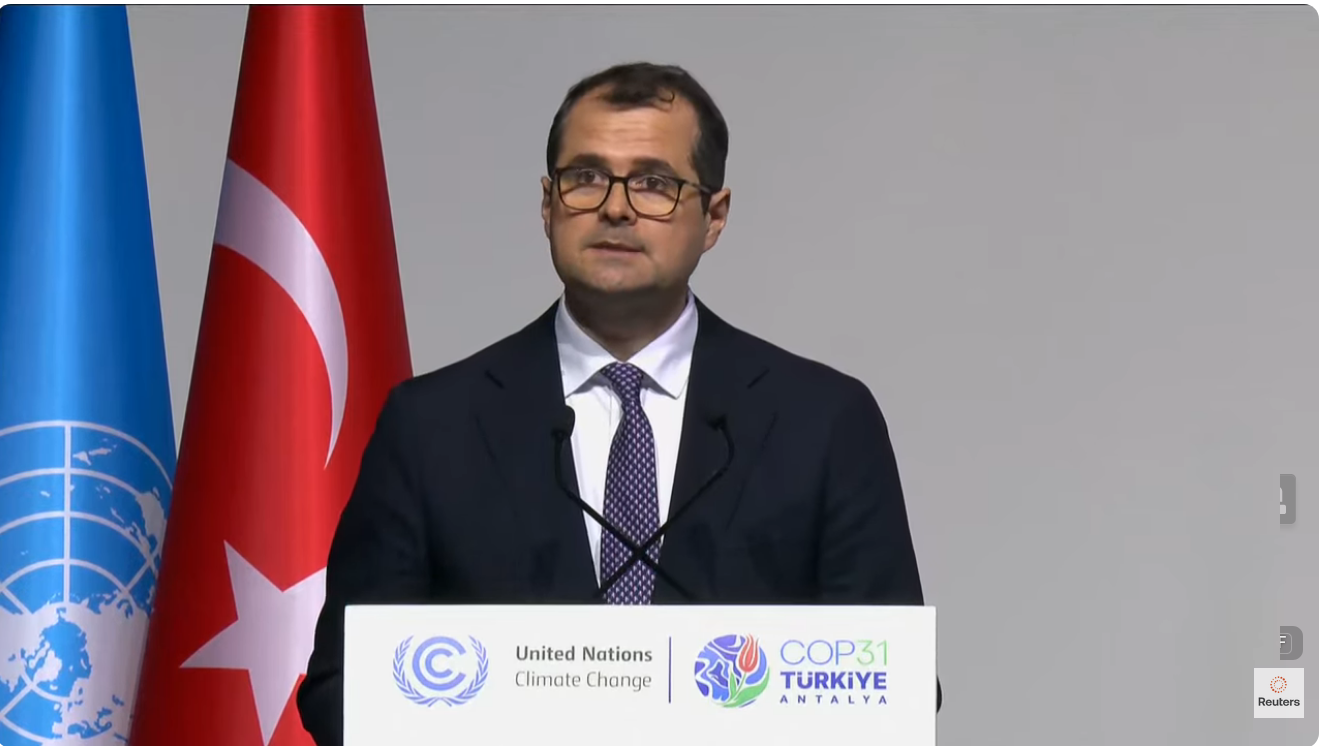
Moldovan PM, at COP31, says Moldova aims to reduce greenhouse gas emissions by 75 per cent by 2035
Moldova aims to reduce its net greenhouse gas emissions by 75 per cent by 2035, compared with 1990 levels and to plant and rehabilitate approximately 145,000 hectares of forest by 2032. Prime Minister Vasile Tofan has spoken about the country’s commitments to combating climate change, investments in renewable energy and the impact of war and drought on water resources in a speech delivered at the UN Climate Change Conference COP31, held in Antalya, Turkey.

The prime minister began his speech by describing two situations this year that had affected water supplies and highlighted Moldova’s vulnerability to the consequences of war and climate change.

“In March this year, families in northern Moldova turned on their taps, but no water came out,” Vasile Tofan said, noting that a Russian attack on a hydropower plant in neighboring Ukraine caused oil to spill downstream into the Dniester River.

“For more days, families living along the river depended on drinking water deliveries,” the prime minister said.

He noted that, several months later, the authorities were once again monitoring the level of the Dniester, this time because of drought. After months of drought, the main upstream water reservoir was more than ten meters below its normal level.

“The government was preparing for the possibility that the pumps might run out of water,” Tofan said.

In the context, the prime minister emphasized that the effects of war, climate change and environmental degradation extended beyond national borders and that countries’ response must be a joint one.

“For a small country like Moldova, the consequences of war, climate change and environmental degradation do not stop at national borders. Neither can our response stop there,” the prime minister said.

Vasile Tofan linked these experiences to the energy crises faced by Moldova, specifying that the country’s security depends on its ability to become more resilient and reduce its dependence on resources it cannot control.

“These experiences have also reinforced a lesson we learned from successive energy crises: our security depends on resilience and on reducing our dependence on resources that we cannot control,” the prime minister said.

Referring to the progress made in the energy sector, Tofan mentioned the increased share of renewable sources in electricity production. While six years ago, they provided approximately 3 per cent of the electricity consumed in the country, their share is now approaching 30 per cent.

“And we are making progress. Just six years ago, renewable sources provided approximately 3 per cent of Moldova’s electricity. Today, that figure is approaching 30 per cent,” the PM said.

He emphasized that producing energy from domestic sources was particularly important for a country that had experienced situations in which energy was used as an instrument of pressure.

“For a country that has experienced energy being used as a weapon, every kilowatt-hour we can produce from our own sun and our own wind gives us a little more freedom,” Vasile Tofan said.

The prime minister noted that increasing clean energy production was not sufficient in itself, as investments are also needed in infrastructure that would enable its use. In this regard, he touched upon the strengthening of connections with European countries and Turkey’s role in implementing energy projects.

“But producing more clean energy is only part of the solution. We must also build the infrastructure needed to make full use of it,” Tofan said.

According to the prime minister, a Turkish company will build a new power line between the municipality of Balti in Moldova and Suceava, Romania.

“Turkey is an important partner in this regard. A Turkish company will build a new power line connecting Balti in Moldova with Suceava in Romania, strengthening our access to the European electricity market,” the prime minister also said.

Another area addressed by the prime minister was the protection of natural resources and the expansion of forested areas. He noted that, through the national afforestation programme, Moldova set the goal of planting and rehabilitating approximately 145,000 hectares of forest by 2032.

All these measures are part of the country’s broader commitment under the Paris Agreement, Tofan said. Moldova has committed to reducing its net greenhouse gas emissions by 75 per cent by 2035, compared with the level recorded in 1990.

“We take this commitment seriously. And we intend to fulfill it,” the prime minister said.

At the same time, Vasile Tofan said that national efforts were not sufficient to combat climate change and called for greater involvement from countries with greater financial resources and greater historical responsibility for greenhouse gas emissions.

In his speech, the prime minister recalled President Maia Sandu’s intervention at COP29, held two years ago in Baku, when she drew attention to the inequity between some countries’ limited contribution to global emissions and the effects they are already facing because of climate change.

“Two years ago, at COP29 in Baku, President Maia Sandu reminded the world of a fundamental injustice: countries like Moldova contribute very little to global emissions; yet our farmers, families, and communities are already paying a high price for climate change,” Vasile Tofan said.

The prime minister noted that Moldova was investing its own resources, transforming its energy sector, protecting its forests, and taking measures to adapt to climate change. At the same time, he emphasized that climate finance must become more accessible and predictable, so that it reaches the countries and communities most in need of support.

“But countries with the greatest resources and the greatest historical responsibility for emissions must also do their part. Climate finance must become more accessible, more predictable and reach the countries and communities that need it most,” the PM said.

In conclusion, Vasile Tofan also said that Moldova was honoring its commitments, despite the difficulties it faces and called for a joint effort by the international community.

“Moldova is doing its part, despite the challenges we face. We ask others to show the same commitment, because no country can combat the climate crisis alone,” the prime minister concluded.

Prime Minister Vasile Tofan attended the 31st session of the Conference of the Parties to the United Nations Framework Convention on Climate Change (COP31), which took place today in Antalya, Turkey.

On the sidelines of the summit, the Moldovan PM met Prime Minister of Kazakhstan Olzhas Bektenov. He also held discussions with President of Slovenia Nataša Pirc Musar, President of Finland Alexander Stubb, President of Bosnia and Herzegovina Denis Bećirović and Prime Minister of Armenia Nikol Pashinyan.

The discussions focused on Moldova’s European path, economic cooperation and investments in the energy sector.

COP31 brings together representatives of states and international organizations for discussions on climate change and measures to combat it.
 Facebook
 Instagram
 X/Twitter
 Telegram
PHOTO // People with disabilities to benefit from improved rehabilitation services; project worth about 2.5 million dollars launched by Moldova's Labour and Social Protection Ministry
Students from Moldova earn three distinctions at International Olympiad on Astronomy and Astrophysics for juniors
Pile-up in Bulgaria; Moldova's Foreign Affairs Ministry says no Moldovan citizens among deceased
Moldova to launch first national campaign to prepare population for crisis situations
Two aerostat-type objects illegally entered national airspace
VIDEO // Defense Minister denies claims of forced return of diaspora in event of state of siege or war
Moldova records 69 airspace violations since early 2026
New EcoVoucher Program session: Around 3,000 families to be able to purchase energy-efficient appliances
Moldova and Romania to implement joint measures to streamline truck traffic at border
Moldova's General Police Inspectorate says aircraft detected in Rezina of Gerbera type, without explosive devices or substances
Rectors, experts from seven countries gather in Chisinau for Congress of Black Sea Universities Network
Investments worth 13.5 billion lei planned in next five years in education system of Moldova: benefits for students, teachers
Drone-like object detected in wooded area nearby north-eastern Moldova village
Moldovan PM says local public administration reform necessary, even though unpopular
PHOTOS // Railway of Moldova enterprises tests new rail route between Straseni, Chisinau and Sangera
Five aerial incidents recorded in Moldova in past week
VIDEO // Ten artificial nests for saker falcon, one thousand bird-protection devices installed on Vulcanesti–Chisinau power line
PHOTO GALLERY // Olympic Bridges: Nadia Comăneci in Chișinău – exhibition dedicated to great champion at Palace of the Republic
DOC // Moldova, United States to sign agreement on protection of classified information
VIDEO // President after EPC summit in Dublin: Moldova has friends in Europe, alongside whom we work shoulder to shoulder
DOC // Government decision on ratification of Moldovan-Ukrainian Agreement on military-technical cooperation published in Official Journal
 National Bank of Moldova

Moldovan PM visits glass fiber materials factory in Straseni, which produces including for Airbus
Reform of Moldova's unified pay system in public sector on agenda of parliament’s plenary meeting on November 16
More than 172,000 public-sector employees to receive higher salaries
Deputy Prime Minister for Reintegration meets Ambassador of Türkiye
Two-million-dollar grant for energy renovation of public buildings in Moldova

VIDEO // President after EPC summit in Dublin: Moldova has friends in Europe, alongside whom we work shoulder to shoulder
Two-million-dollar grant for energy renovation of public buildings in Moldova
DOC // Government decision on ratification of Moldovan-Ukrainian Agreement on military-technical cooperation published in Official Journal
Weather to sharply cool in Moldova
Moldovan Ambassador, Chinese officials discuss country’s inclusion in China’s tourist destinations program
DOC // Foreign nationals in Moldova to benefit from Romanian-language courses and integration support
Moldova wins seven medals at competition in Turkey
PHOTO // National Bank of Moldova launches commemorative coin dedicated to Nadia Comăneci and first perfect 10 in gymnastics history
Moldovan president, European leaders in Dublin focus on Moldova's security, next steps in EU accession process
Fragments of aircraft found in vineyard in Ștefan Vodă
Moldovan government's secretary general participates in annual Interreg 2026 event in Brussels
Moldovan president, at EPC Summit in Dublin: “We discussed the next steps in the country’s accession to the EU”
Moldova's judges, prosecutors to be able to continue external evaluation after submitting resignation application; parliament to amend legislation following Constitutional Court's ruling
Joint commission for decentralization resumes work in Moldova: local public administration reform, investments' financing on agenda of discussions
Proposals for 2027–2030 public administration reform's implementation programme discussed at workshop in Moldova
Moldovan economic development minister, U.S. Ambassador to Moldova discuss opportunities to deepen bilateral economic relations
Receive the latest news directly to your email

Receive the latest news directly to your email