
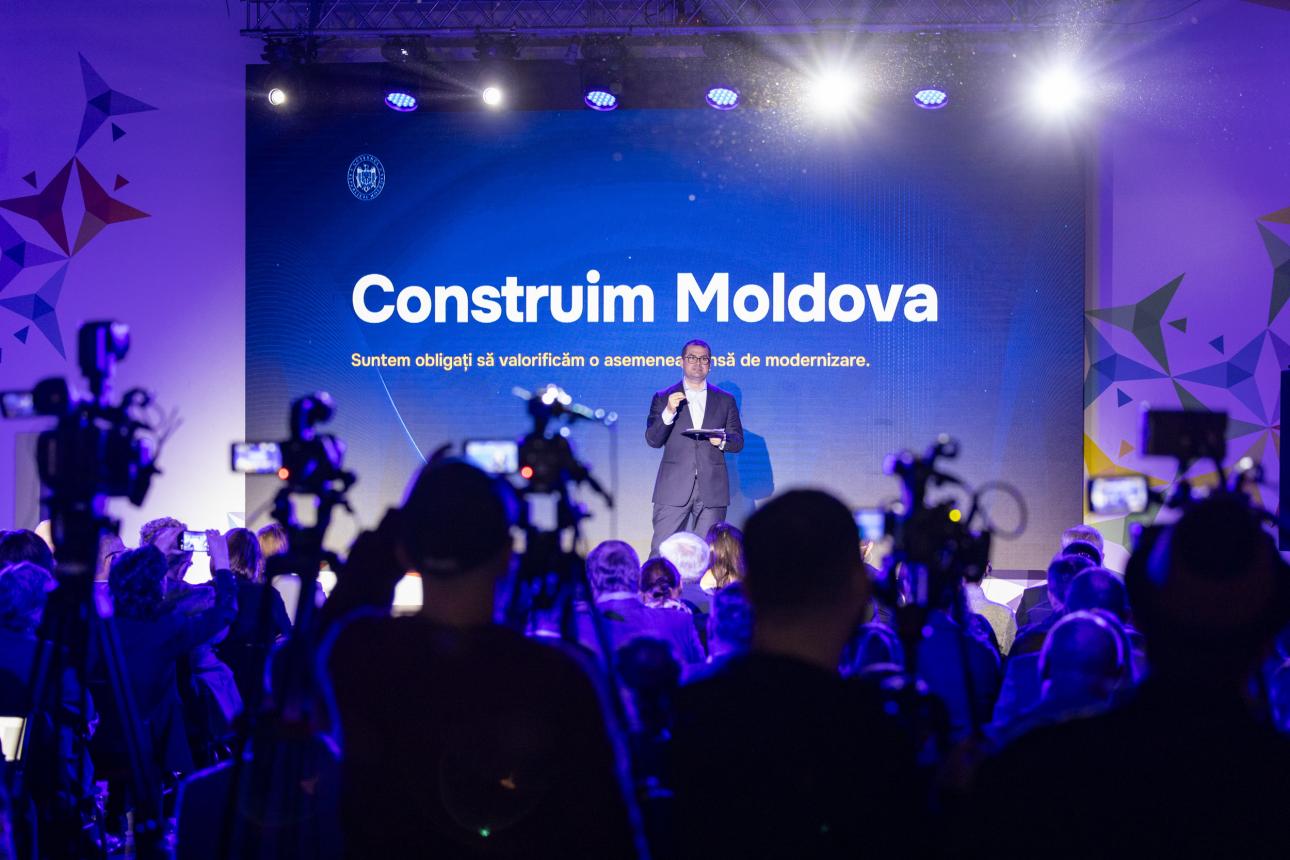
Moldovan PM, at Building Moldova event: ''A European country is not declared, it is built''
The government today presented 19 strategic investment projects to be implemented in the coming years with the support of the European Union through the Growth Plan for Moldova. The projects target five priority areas—energy, infrastructure, agriculture, education and healthcare—and aim to modernize the country and improve citizens’ living conditions. The investments will be financed through the Growth Plan for Moldova, with additional financial resources mobilized, including from international development partners.

At the Building Moldova event, Prime Minister Vasile Tofan and the cabinet members discussed the main investments planned, the expected results and the implementation stages of the projects.

“We have a historic opportunity—to invest the resources provided through the Growth Plan, in order to improve the lives of Moldovans. A European country is not declared; a European country is built,” Prime Minister Vasile Tofan said.

The PM emphasized that joining the European Union meant not only reforms and negotiations, but also concrete investments that can be seen in localities across Moldova. The government aims to accelerate the implementation of strategic projects, in order to close the development gap with European countries as quickly as possible.

The 19 projects are at different stages of preparation and implementation—some are already advanced, while others are at the stage of technical feasibility studies. The prime minister stressed that the government’s priority was to accelerate the work and complete the investments within the established deadlines: “We want to compress into a few years projects that took decades in other countries.”

In the energy sector, the investments aim to enhance energy security and reduce costs for consumers. Energy-efficiency works are planned for 1,400 homes and 40 public buildings, along with the modernization of Chisinau’s district heating system, the construction of the Balti–Dnestrovsk power line and the modernization of the national electricity networks. The modernization of the capital’s district heating system alone is expected to save approximately 4.5 million cubic meters of natural gas.

In infrastructure, the projects include the construction of the first motorway in Moldova, the development of the Chisinau bypass, the renovation of important roads and the construction of a new terminal at the Chisinau International Airport. At the same time, investments in water supply systems will ensure access to safe water for approximately 700,000 people.

To develop a profitable and competitive agricultural sector, investments are planned in irrigation systems, covering 6,900 hectares of agricultural land, the continuation of the Moldova Orchard II programme and the provision of more than 43 million dollars in financial support for small farmers.

In education, the government plans to modernize 20 model schools, renovate six universities, 24 academic buildings and 23 dormitories at technical vocational education institutions. The construction of Moldova’s first technology campus—HiTech Park Stauceni—is also planned. It will create new opportunities for young people, research and the development of the technology sector.

In healthcare, the investments target the modernization of 10 rural health centers, the development of Balti Regional Hospital and the establishment of a center for managing special waste. The projects will help improve access to quality medical services, including for residents of the regions.

To ensure faster projects’ implementation, the government plans to create a single structure for managing strategic investments—Moldova Project. It will help reduce delays caused by approval procedures, tenders and appeals, as well as improve coordination among the competent institutions.

The PM also noted that Moldova already had concrete results in using the funds provided through the Growth Plan. Presently, 425 projects are either under implementation or completed, of which 177 have been finalized. As many 374 of the total number represent investments at the local level.

Completed projects include the modernization of the wastewater treatment plant in Zabriceni, northern Edinet district; the expansion of water supply networks in Hajdieni, Glodeni district; the renovation of roads and educational institutions in Nisporeni; the establishment of the first nursery for children up to three years old in Hancesti, as well as the modernization of kindergartens in Chisinau. Investments in roads’ infrastructure have also been carried out in the localities of Corjova, Bocani, Clocusna, Sipoteni, Pelinei and Ghetlova.

The prime minister emphasized that projects’ implementation would be monitored transparently and citizens would be able to track the progress of each investment, including the implementation stages and any delays. Information about the 19 strategic projects and their implementation progress is available on the dedicated platform: https://gov.md/construimmoldova/.

The European Union’s Growth Plan, with a total value of 1.9 billion euros, is a support programme provided by the European Union for projects that contribute to the country’s economic and social development, infrastructure’s modernization and improved living conditions for citizens. To date, our country has received 504 million euros from the EU and the European Commission has recently disbursed an additional 157 million euros. The allocation of funds is conditional on progress in implementing the reforms agreed.
 Facebook
 Instagram
 X/Twitter
 Telegram
Moldovan government launches new round of public consultations on legislative package for local public administration reform
Moldovan parliament speaker, at meeting with Romania’s PM: “We need more bridges over the Prut and fewer borders between us”
Moldovan PM says Moldova, Romania connected by future countries want to build together
Moldovan PM's address at joint news conference with Romanian counterpart
Deputy Prime Minister for Reintegration meets with Croatia’s State Secretary for European Affairs
Moldovan President held farewell meeting with Slovak Ambassador
Deputy Prime Minister for Reintegration holds talks with Romanian Foreign Minister
Prime Minister encouraged Ukrainian entrepreneurs to invest in Moldova
Moldovan Prime Minister in talks with Ukrainian President
Prime Minister following meeting with Ukrainian counterpart: Every day Ukrainians defend their cities, families and freedom, they also contribute to security of Moldova
Speech by Prime Minister following meeting with Ukrainian counterpart
Prime Minister attends Kyiv International Economic Forum
Prime Minister's speech at Kyiv International Economic Forum
Moldovan PM pays working visit to Ukraine: meeting with Ukrainian head of state, participation in International Economic Forum
BUILDING MOLDOVA // Authorities accelerate preparations for construction of Chisinau bypass road
VIDEO // Moldovan parliament speaker says farmers need solutions, not politicians who speak on their behalf
Moldovan president revokes Moldova's citizenship from three individuals
BUILDING MOLDOVA // Deputy PM says more than 95 per cent of Moldova’s settlements set to have access to tap water by 2030
Moldovan PM, at Building Moldova event: ''A European country is not declared, it is built''
BUILDING MOLDOVA // Moldova to have center for collection, processing of special waste
Chisinau Electrical Substation enters inspection stage ahead of energization
 National Bank of Moldova

Moldovan president revokes Moldova's citizenship from three individuals
Moldovan parliament approves, in first reading, denunciation of two agreements with Commonwealth of Independent States that were not implemented
Licensing of cereal and oilseed imports extended by late 2026
Moldova to strengthen integrity of electoral processes by joining International IDEA
Moldova aligns audiovisual legislation with European standards


Licensing of cereal and oilseed imports extended by late 2026
UPDATE // Heavy cross-border traffic at Leușeni Border Crossing Point eased
BUILDING MOLDOVA // New runway and terminal at Chișinău Airport
Over 2,400 students from 31 countries admitted to Moldova’s universities
Moldova to strengthen integrity of electoral processes by joining International IDEA
New guide set with Sweden’s support explains investigation of pollution, poaching and illegal logging
BUILDING MOLDOVA // Schools and universities at heart of European investment
BUILDING MOLDOVA // Deputy Prime Minister: Ungheni–Chișinău highway to put Moldova on European Union’s map
Moldova aligns audiovisual legislation with European standards
BUILDING MOLDOVA // Agriculture to be based on science and smart solutions
Small farms in villages to be able to operate under clearly established conditions
National legislation on electronic evidence adjusted to international standards
Regulatory framework on civil protection and fire safety aligned with European standards
Romanian language courses and integration support for foreigners in Moldova: Parliament passed bill on integration of foreigners
Passed by Parliament: Tractors and agricultural machinery to be type-approved in line with European standards
Taras Shevchenko gymnasium's library enriched with Ukrainian children’s literature
Receive the latest news directly to your email

Receive the latest news directly to your email