
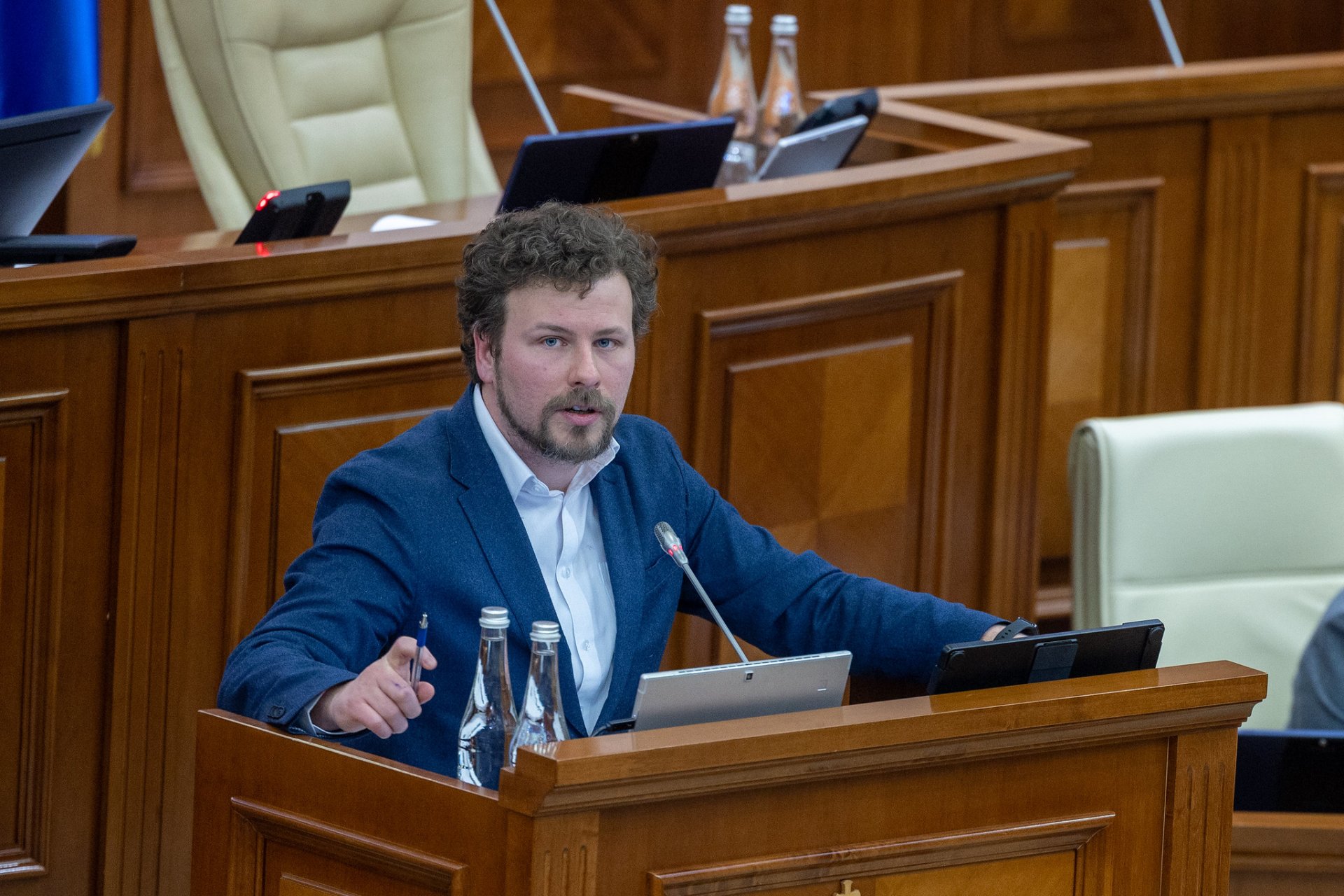
Moldovan MPs approve major changes to Education Code
Education and Research Minister Dan Perciun in parliament today presented the main amendments due to be made to the Education Code. The changes aim to ensure Romanian language learning programmes for children in the Diaspora, the inclusion of children with severe disabilities, the reintroduction of marks for 4th grade students, the consolidation of the schools’ network and measures to support young specialists.

At the parliament’s rostrum, Dan Perciun said that these amendments were not populist and would cost the ruling party politically. He specified that he assumes these political costs, because they did not come to govern for life, but to respond to major challenges.

“We, at the Action and Solidarity Party (PAS), are aware that both the administrative-territorial reform and the amendments to the Education Code will cost us politically. But we did not come to power to stay for life or to be concerned only with our own interest. As a society, we must respond to major challenges. And even if these answers cost us politically, they are necessary and we will implement them,” the minister said.

He noted that the changes were urgently needed and would also enhance the attractiveness of universities from Moldova.

Language integration programmes for children returning from the Diaspora

“I believe that, regardless of the parties we represent today, our common goal is for every child of Moldova to benefit from quality education. It is important that, each time we come to the parliament’s plenum, we try to look for reasonable solutions. And when it comes to education, we should leave political debates aside and seek constructive solutions to the main challenges of our education system. Centralized piloting will try to take into account the specific realities of each family and each child. This is a very important step for our country to support the return of young families. Surely, I do not think there is anyone who would not want to see more young families staying in Moldova and, moreover, coming back to Moldova,” the minister said.

Support in general education institutions for children with disabilities

“Another issue that the Code or the amendments seek to address is a very painful one and has been intensely discussed in the last 10 years. We have made extraordinary progress regarding school inclusion: children with special educational needs and children with disabilities are no longer isolated somewhere outside society, but are included in our general education schools. They are fully part of school communities, are visible and appreciated citizens and their problems and realities are known. We must admit, however, that we still have much work to do on the integration of children with severe disabilities. The system does not provide an inclusion model tailored to their specific needs, and teachers do not always have the necessary support, especially in institutions with large classes of 35–40 children. This amendment provides for the creation of support groups dedicated to children with severe mental disabilities, with up to six children, in which two trained adults work: a support teacher and, if necessary, a psycho-pedagogue or social specialist, in order to respond to their specific needs with an adapted schedule and curriculum. At the same time, they remain an integral part of the school community. This is the compromise solution we want to identify: targeted support, but not outside the institution, rather inside it, while children remain a full part of the social process taking place in a school. They participate in artistic, sports and extracurricular activities, spend time together with other children and benefit from additional support for their specific needs. The curriculum for these children will have a slightly different dimension, being focused more on self-care and independent living skills, which are fundamental needs in addition to standard academic elements,” added Dan Perciun.

He specified that another challenge for the system, which relates not only to education, but also to the social context, was the reality of children and families who are currently studying in special schools.

“We are talking about severe disabilities, especially mental. After the 9th grade, the family does not always have a solution for these children, because there are not enough day centers. Thus, we ruled to extend the possibility for these children to remain in educational institutions up to the 12th grade. We have already piloted this solution in 2025, in partnership with colleagues from Chisinau, and we have the first generation of young people who, after the 9th grade, remained at these educational institutions, benefiting from continued access to education, while their parents can continue their professional activity. At the same time, we must provide solutions after the completion of the 12th grade as well, within social services. This is a temporary, good and necessary solution, but we will have to return to a serious discussion on expanding the available social services.”

Fourth grade students will receive marks

The education minister pointed out that another important amendment referred to the reintroduction of grading for 4th grade students, but only for exam subjects.

Good news for young specialists

Furthermore, the Education Ministry will introduce mechanisms for assigning young specialists after graduation not only to schools and kindergartens, but also to other structures of the education system.

“We have increased the placement allowance from 120,000 to 200,000 lei for schools and kindergartens, and this mechanism will be extended to vocational schools, colleges, universities and research institutes.”

“As for the university governance, there are two main models: the Anglo-Saxon and the Continental European. The Anglo-Saxon model views the rector as a chief executive officer elected by a board, with no term limits. The Continental European model, predominant in the European Union and applied in Moldova, limits the rectors’ terms and sees them as representatives of the academic community. In the context of consolidating the university network, we integrated universities and research institutes, which led to an increase in the number of students, teachers and to improved research quality. Amendments to the Education Code allow rectors who managed these complex processes to run for a third term, in order to ensure continuity of reforms,” the minister stated.

Schools with more than 400 students will switch to financial autonomy

Perciun said that one of the most sensitive amendments concerned the consolidation of the schools’ network.

“All schools with more than 40 pupils will have autonomous financial management, which allows them to manage their own budget and procurement, making teachers and school managers more accountable and reducing their dependence on district education directorates. Today, the school network is fragmented: every fourth school has fewer than 100 pupils and every tenth has fewer than 50. These imbalances affect the quality of education. We are analyzing the correlation between the number of students and school performance, in order to make well-founded decisions. Our strategic objective is for every student, regardless of where they were born or their family background, to benefit from quality education and to realize their potential. This is the essence of the discussion and of the decisions proposed.”

Consolidation of the university network

Regarding the process of consolidating the university network, Perciun said that Moldova had gone over the last four years through a complex but extremely necessary process of integrating research institutes into universities and consolidating the university network. In 2022, three universities became part of other universities, and in addition, 19 research institutes previously under the authority of the Academy of Sciences or the Ministry of Education were fully integrated into universities.

“In 2024, other consolidation processes continued, including the integration of the University of Cahul into the Technical University. This was a national strategy meant to enhance the efficiency of the higher education system and to strengthen academic communities. As a result of these processes, we achieved remarkable results: in 2025, admissions to universities of Moldova reached the highest level in the last 10 years – 15,925 young people admitted. We increased the number of young specialists assigned to schools and kindergartens and centralized their integration process, offering them support for three years. The number of students increased significantly, and teaching staff and researchers doubled in many universities. We decided to continue this reform by absorbing smaller institutions, in order to facilitate integration and avoid creating new institutions with separate structures, which would have complicated administration and affected the continuity of rectors’ terms. Thus, the amendments to the Education Code allow rectors who have implemented these processes to run for a third term, as an exception, in order to ensure the continuity of reforms. These amendments reflect the realities and specific context of Moldova: consolidating universities, integrating research institutes and creating stronger academic communities capable of managing a rapid increase in the number of students and teaching staff,” Perciun concluded.

Consolidation of the school network and support for students and teachers

Based on the proposed criteria, 73 schools are to be reorganized, of which 10 will be transformed into kindergartens, 43 into primary schools, and 17 into primary school–kindergarten institutions. The total number of schools concerned represents approximately six per cent of the total number of public school institutions of the country. In total, 1,200–1,300 children will be affected by this measure, which represents only 0.5 per cent of all students of Moldova.

The authorities will also introduce support measures for families and teachers. Thus, school transport will be free and parents of students who will be transferred to other institutions will receive a monthly allowance of 1,000 lei during two years of studies. Teachers affected by the reorganization will benefit from support through professional retraining, relocation and coverage of transport costs. Teachers who will not be able to get a job in their district will be able to receive a relocation allowance of up to 300,000 lei to take up a job in another district. Eligibility criteria and the procedure for granting this allowance will be further regulated by the government.
 Facebook
 Instagram
 X/Twitter
 Telegram
One-billion-dollar theft file: former Moldovan Democratic Party's leader to appear before judges on February 12
Meter Aid programme: Moldovan state starts paying heating compensation for last January
Moldova, Israel join forces in emergency medicine, health innovation
Over 600 lyceum pupils of Moldova to help middle school graduates prepare for math exam
Police label incident at church in central Moldova village as provocation; details on dispute over usage rights
Good news for students willing grade 10 ex officio in foreign language baccalaureate exam: Moldovan Education Ministry updates methodology
Over 120 schools held online classes on Monday
Nicolae Testemițanu USMF professors on training mission at University of Rouen
Winter conditions on national roads: partly covered with ice or snow
New measures on firearms regulation
PHOTO // Several resident doctors from “Nicolae Testemițanu” USMF took part in a course on intensive care skills training
Unemployed people can receive grants to start business
Around 4,400 fathers to receive paternity benefits in 2025
PHOTO // All national routes passable
Good news for elderly people of Moldova: pensions to increase in next spring
Spring Festival celebrated in Moldovan capital: Chinese show on stage of Mihai Eminescu Theatre dedicated to Year of Fire Horse
Moldova national football team learns UEFA Nations League opponents: tough group C Draw for country – Kazakhstan, Slovakia, Faroe Islands
Moldova may negotiate new programme with IMF: decision expected on February 27
NATO Secretary General expresses full confidence in Moldovan president
Moldovan parliament approves amendments to Education Code in first reading
Moldovan MPs approve major changes to Education Code
 National Bank of Moldova
Thirty four sustainable development projects implemented through Moldova's reintegration activities programme in 2025
Authorized by European Commission: Fresh poultry meat, poultry meat products can be exported to EU from entire territory of Moldova
Moldovan President to attend Munich Security Conference
Moldovan PM says government acts to achieve three major objectives – economic growth, faster EU accession, peace, security at home
Moldovan president highlights importance of preserving Gagauz language, culture at Comrat University

Hearing of former leader of Moldovan Democratic Party in bank fraud file postponed after he claims illness
European MP says Moldova has opportunity to break away from the harmful influence of East, take rightful place in European family
Moldovan parliament ratifies amendments to Moldova–Turkey Free Trade Agreement
European Parliament members to support Moldovan lawmakers in transposing EU legislation
Companies from several countries gathered in Chișinău for Business Forum Made in Moldova – Internationally Competitive
Speaker about situation of Dereneu church: Law must be applied to everyone, without discrimination
Poultry meat from Moldova reaches EU market: authorization for entire country
Liliana Nicolaescu-Onofrei about situation at Dereneu church: Law enforcement bodies to clarify entire situation
Moldovan Constitutional Court validates MP's mandate
Fallen soldiers of Afghan war commemorated in Parliament
Chisinau residents to pay less for heating
Energy reforms and investment plans presented to Fitch experts during country rating review
Over 500 refugee children from Ukraine learn Romanian for free in schools of Moldova
Moldovan President to attend Munich Security Conference
First electrified railway with European gauge on Chisinau–Ungheni segment: feasibility study to be completed in 2026
Moldovan PM says government acts to achieve three major objectives – economic growth, faster EU accession, peace, security at home
Receive the latest news directly to your email

Receive the latest news directly to your email