
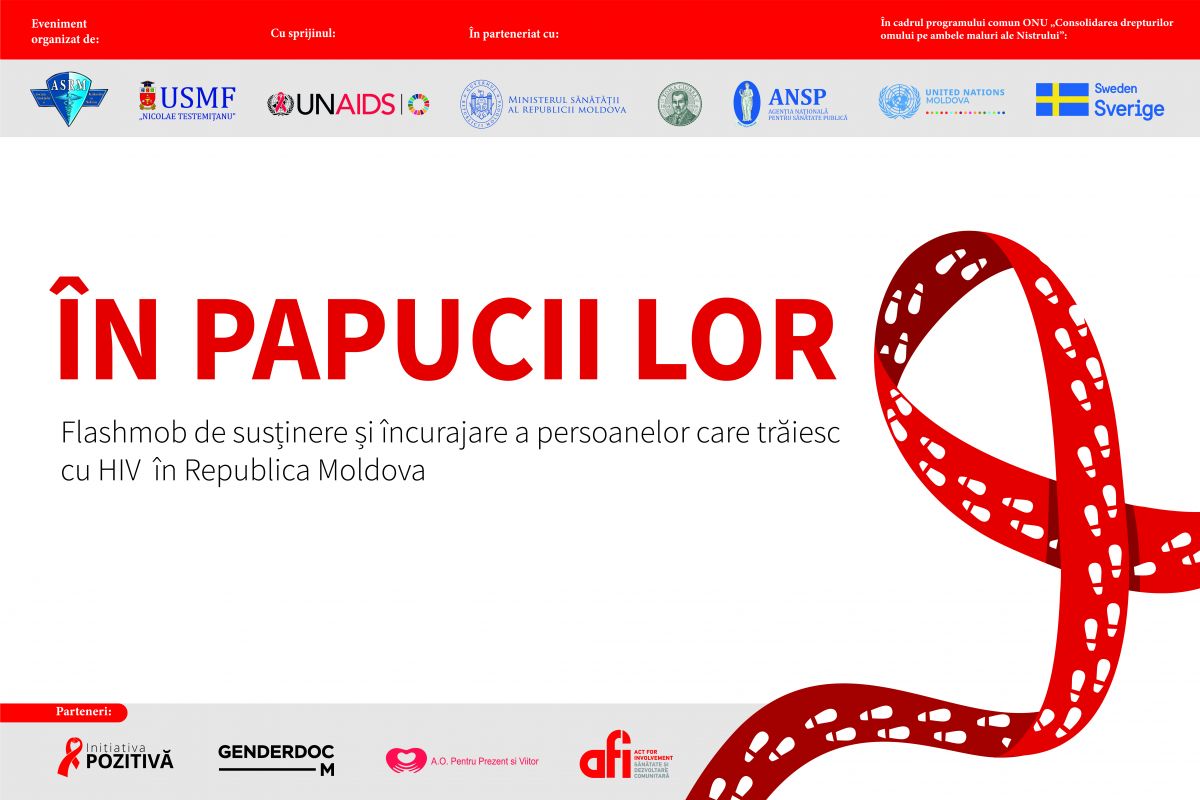
Flashmob in support of people with HIV organized in Moldovan capital
In the capital, a flashmob titled "In Their Shoes" will be organized on 18 May in the context of World AIDS Day.

According to "Nicolae Testemițanu" State University of Medicine and Pharmacy, the event emphasizes that through testing and treatment, a person with HIV can live like everyone else, and when we step into someone else's shoes, we are not indifferent but unite efforts to find a solution.

The event will begin at 10:30 AM with a symbolic march in the center of Valea Trandafirilor Park in the capital.

Participants – students, resident doctors, teachers and others interested – will walk a distance of 838 meters, each meter being a gesture of solidarity and support for the courage of the 838 people who chose treatment and life in 2024, and a message that no one is left behind. The young participants will form a circle around the lake, and upon reaching the final point of the route, they will outline the sole of their footwear on the asphalt with colored chalk and write a message of encouragement, empathy, hope and support.

The activity is organized by the Association of Medical Students and Residents and "Nicolae Testemițanu" State University of Medicine and Pharmacy from the Republic of Moldova, with support of UNAIDS Moldova/Joint United Nations Program on HIV/AIDS, in partnership with the Ministry of Health of the Republic of Moldova, "Toma Ciorbă" Infectious Diseases Clinical Hospital and the National Public Health Agency.

The event takes place within the joint program Strengthening Human Rights on both Banks of the Dniester implemented by the UN with financial support from the Embassy of Sweden in the Republic of Moldova.

It is estimated that currently, there are 16,860 diagnosed people with HIV in the Republic of Moldova, and around 880 new cases were registered in 2024. Thanks to improved access to services, the number of AIDS-related deaths has significantly decreased – from 338 in 2020 to 241 in 2024. However, fear and stigma remain major barriers preventing many from getting tested or following treatment.
 Facebook
 Instagram
 X/Twitter
 Telegram
Support for students relocated to larger schools: Ministry of Education announces measures to facilitate transition
Former Democratic Leader Vladimir Plahotniuc and Serghei Iaralov might testify in 'Kuliok' case
Moldova moves towards EU standards - Natura 2000, with concrete steps for environmental protection
Moldovan education minister reacts to initiative for capital's pupils to take drug tests
VIDEO // Moldovan health minister says regional hospitals from Cahul, Balti expected to be completed by 2031
Citizens returning from Diaspora to continue to benefit from tax, customs facilities for import of personal use goods
Moldovans who worked in Canada to receive social benefits
Moldovan government approves compensation payments for public sector employees
Moldova's National Army receives batch of assistance on behalf of North Atlantic Alliance
Pensions and other social benefits for Moldovans settled in Croatia
VIDEO // Lower taxes for parents paying for children's education in Moldova
Warning for Moldovan citizens intending to travel or transit Lithuania
Education Minister responds to parties discontent with education reform: Ministry focusing on quality
Republic of Moldova extends temporary protection mechanism for Ukrainians
VIDEO // Prime Minister urges people to buy local products as part of Buy GOOD from home campaign
New opportunities for exporting companies: China invites Moldova to international fairs
GIFT EXPO-2025 Exhibition: Moldexpo to host Moldova's only Christmas tree adorned by local producers
Draft law on mandatory health insurance funds for 2026 passed in first reading: more funds for medical services and compensated medicines
VIDEO // Parents can benefit from tax deductions for children's education: Minister of Education explains procedure
State Social Insurance Budget Law for 2026 approved in first reading: indexed pensions and increased allowances
State Budget for 2026 approved by Parliament in first reading
 National Bank of Moldova
Moldovan PM urges to cherish inherited cultural heritage, protect it for future generations
Moldovan head of state, President of Cyprus discuss European integration
President’s speech at joint press conference with President of the Republic of Cyprus
Meter assistance: Over 1.2 million citizens to receive compensation during cold season
Deputy Prime Minister for Reintegration on working visit to Dubăsari district

Moldovan PM urges to cherish inherited cultural heritage, protect it for future generations
Zero rate extended, deductions for education, facilities for green energy in Moldova: what fiscal package approved in first reading includes
VIDEO // One decade of agricultural transformations: MAC-P concludes mission in Moldova with multiple development projects, support for farmers
Moldovan education minister has talks with teachers, students from Cahul
VIDEO// Moldova, Romania join forces against organized crime
Moldovan head of state, President of Cyprus discuss European integration
Moldova takes over presidency of Council of Culture Ministers of South-East Europe for 2026
ANRE: Proportion of emergency electricity in total monthly consumption about 0.2 percent
Moldovan President in talks with Cyprus counterpart
President’s speech at joint press conference with President of the Republic of Cyprus
Less bureaucracy for entrepreneurs: Parliament reduces procedures for permissive acts
Prime Minister: Government stands by citizens during cold season through Meter Aid Program
Meter assistance: Over 1.2 million citizens to receive compensation during cold season
Speaker shares details on Washington talks: They were very good
Public safety - priority at events: Parliament approved strict regulations
New law on weapons: digital record, mandatory training, European passport
Receive the latest news directly to your email

Receive the latest news directly to your email